

Are we Monogamous or Polygamous?
Or just running in circles?

Look across cultures and what you see is variability. Count by society, the way the Standard Cross-Cultural Sample does, and the most common system is mild polygyny followed by general polygyny. Count the actual relationships inside those societies, and most are monogamous anyway, because polygyny is often for a minority. You could try to count by population size but populations vary and past data are scarce. In modern populations you have monogamy almost everywhere.
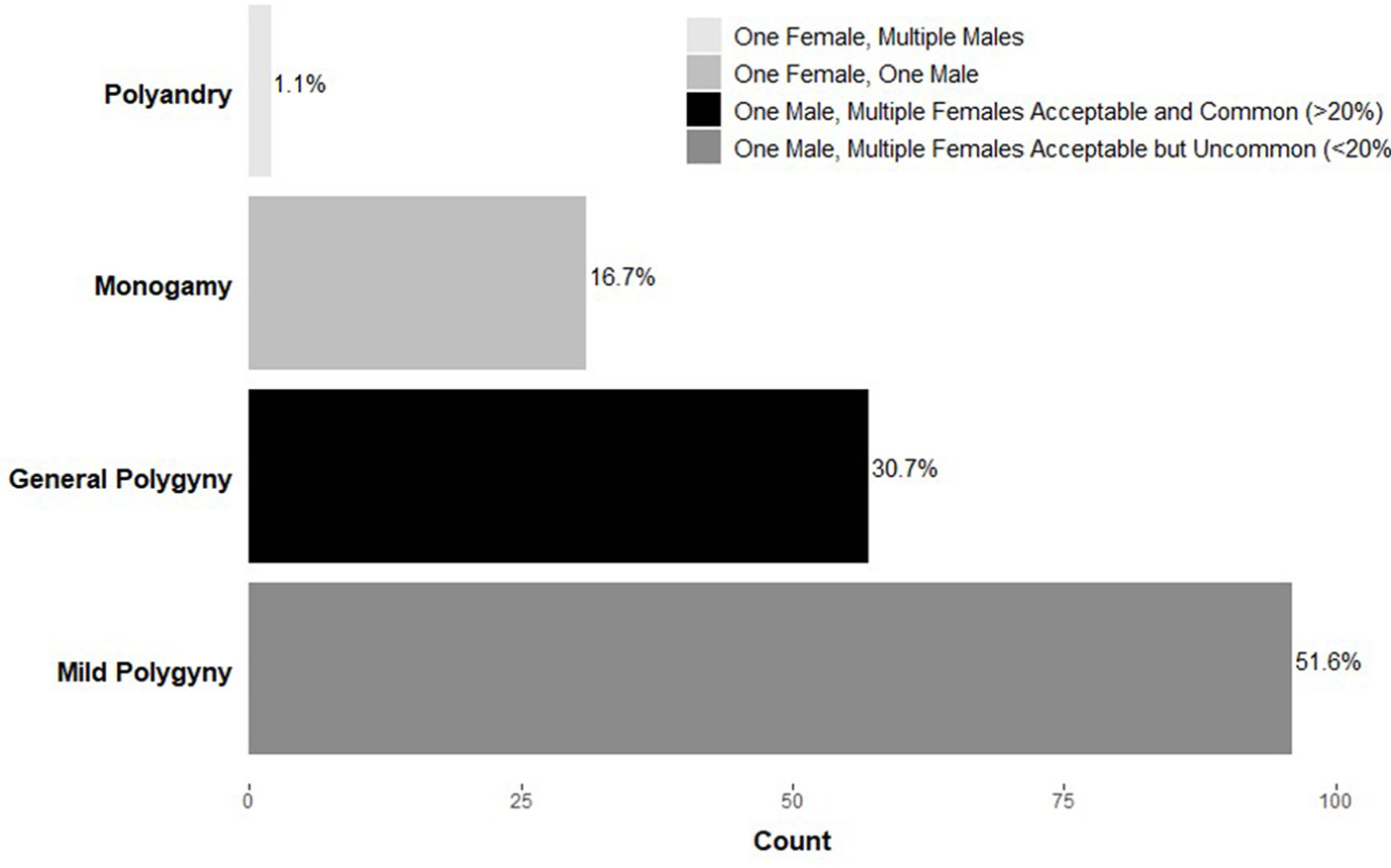
Reminder and definition used moving forward:
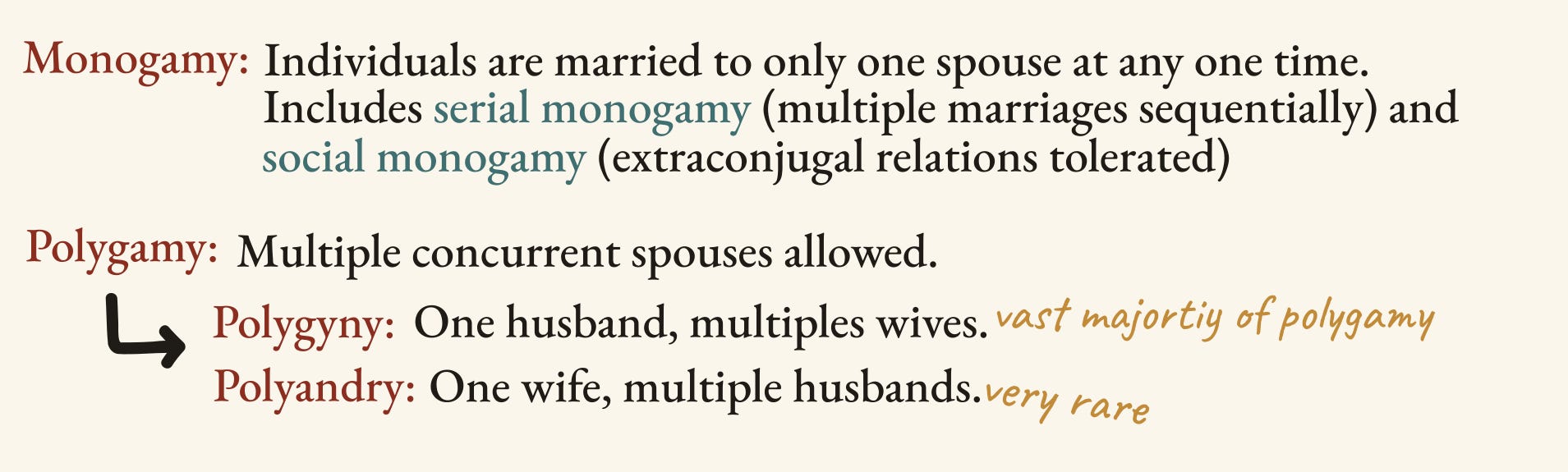
So, what is the answer? Maybe there isn’t one to dig up. Many things in psychology are “Gardens, Not Digsites” situations. A digsite uncovers buried truths. And the deep truth about humans, when you dig, usually turns out to be “it depends on the situation”. It is different in a garden where the plants aren’t the mystery to be solved (we know people have sex). The mystery is the soil. Change the conditions and the same seed will grow into trees of many different shapes. Pre-industrial samples show many societies permit polygyny but now monogamy is the norm.
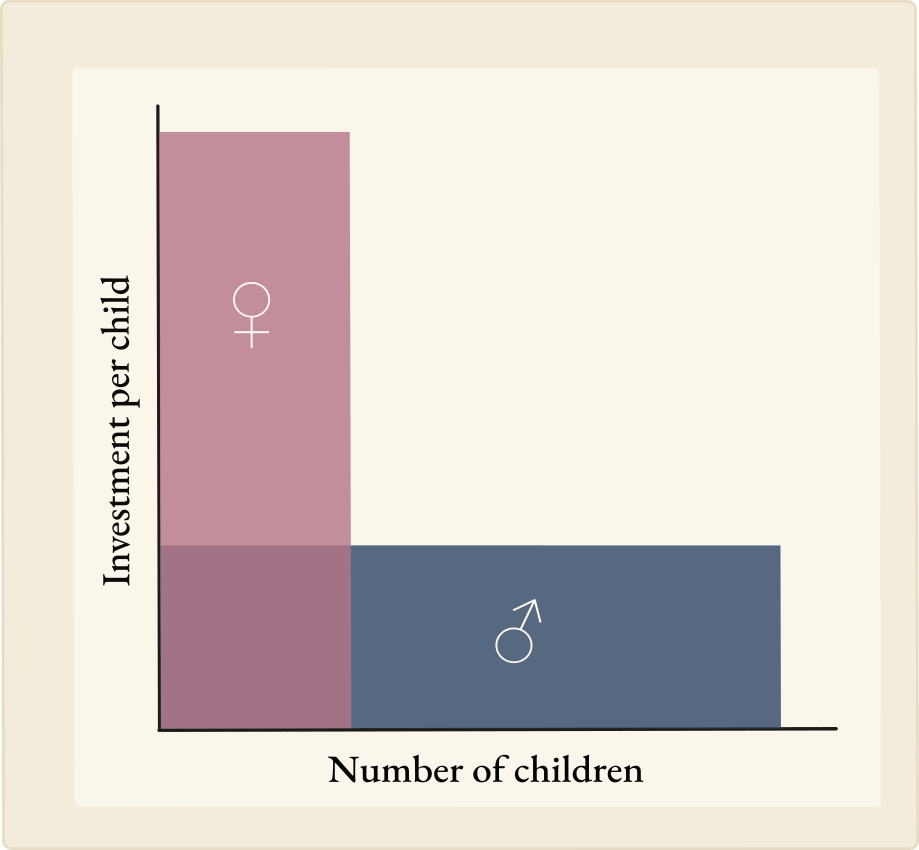
The investigation starts with natural selection. Natural selection is not just about having the most children but more like the most surviving relatives and grandchildren1. This is a different calculation, one in which the number of children is balanced against the investment in their success.
Since every child has one mother and one father, the total reproductive success of all males equals that of all females. So, a sexual system has to work for both sexes at once, but not necessarily in the same way.
Sexual reproduction has a built-in asymmetry where females bear the unavoidable physiological costs of pregnancy and lactation (in mammals) for several years. In most primates, this means 4 or 5 children maximum within the fertility window which skews female reproductive interest toward high investment in the success of her children. No wonder polyandry is so rare if we define it as a perfect symmetry to polygyny.
By contrast, male reproductive success is often better served by investing more in mating opportunities. While they also need someone to care for their children, in a standoff between 9 months of pregnancy and a few minutes of sex, guess who blinks first?
This strategic tension is not deterministic but it is the stage on which environment applies its effects. And at the center of this stage is energy. From chimps to modern cities where calories come from decides who has time, who depends on whom, and ultimately who pairs with whom.
Everything is about sex, except sex which is about food
In some primates, males guard females obsessively. In others, they barely know which offspring are theirs. Yet both gorillas and chimps originated from the same common ancestor we did. What shaped their mating systems probably shaped ours too. So, what is it? And why is it food?
Mountain gorillas feed mostly on abundant foliage such as leaves and stems. Because this food is everywhere, within their mountains, large groups can remain together without exhausting their surroundings. Chimpanzees, by contrast, depend heavily on fruit supplemented by leaves. Fruit is richer, but also patchier and more seasonal, forcing chimpanzees to travel several kilometers a day to the half kilometer of gorillas.
When food is abundant in a delimited space then female gorillas stay together. Males wanting to mate then are all competing in the same space. In this winner-take-all situation, the stronger male keeps the others away and maintains a harem-like structure, polygamy, centered around one dominant silverback. The silverback then has incentives to defend his family group not just against opportunistic males but also external threats like rival males resorting to infanticide to bring females back into fertility sooner.
What do females get out of this arrangement? Females are free to roam and when deciding to join a family it is not only for the dominant gorilla’s genes and protection but also for his potential support when comes the time for her children to make a bid for dominance.
Smart investment also means diversifying the portfolio. Despite their attempt at exclusive reproductive access, dominant silverbacks are only about 70% successful. Very high but not the 100% we might have imagined. In practice females quietly mate with subordinate or outside males, diversifying paternity and ensuring support of other male gorillas. This is possible because they make tracking fertility period difficult, with no outward sign of ovulation and by having sex outside ovulation period. Hidden behind the obvious male polygyny, this female strategy looks a lot like what effective polyandry would be, not the mirror-of-polygyny kind that barely exists.
Chimpanzee foraging in large zones means that groups constantly split into smaller foraging parties before coming back together later. Think a vacation with 150 people where each activity fits four. This “fission-fusion” organization makes males control almost impossible.
Mating with the dominant male offers females nothing. He cannot protect their child when they split to forage, and a child known to be his becomes a target for his rivals. Male chimps protect no one in particular, only the territory. The female solution inverts the gorilla one, they broadcast fertility, advertise ovulation openly and mate with many males during the fertile window. Selection moves to sperm competition and no male knows which child is his. That’s exactly the point, plausible paternity as protection.
“A maximally swollen female chimp mates 1–4 times an hour with thirteen or more partners. Over her lifetime, she will engage in some six thousand or more copulations with dozens of partners, in order to produce no more than five or so surviving offspring”- source
Same primate biology, different soil. Under immobile and abundant resources male gorillas grew twice the size of females, with mixed polygyny and polyandry. Under dispersed resources chimpanzees grew promiscuous, male only 30% larger than females but with testicles proportionally larger than their brains. Whatever works for you, I guess. Time to see what soil we evolved in and what works for us.
Fighting for…Cooperation?
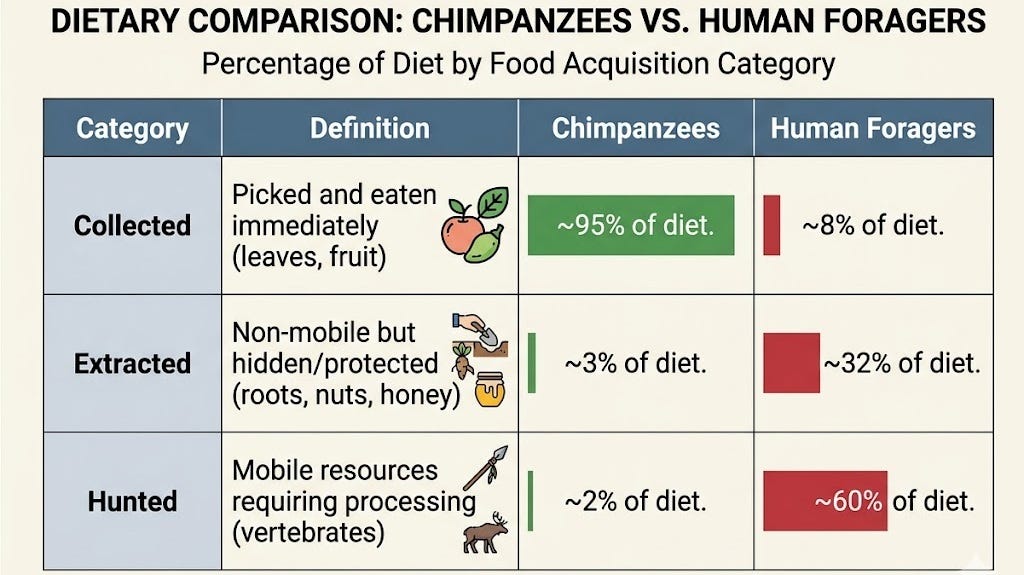
Humans, by contrast to chimps, gather very little but extract about 32% and hunt for 60% of their food.
Gathering fruit or leaves can be learned comparatively early, but hunting and extractive foraging demand years of accumulated skill, coordination, memory, and tool use. As a result, where a young chimp becomes largely self-sufficient by age five, human net production remains negative until ages 18 to 20.
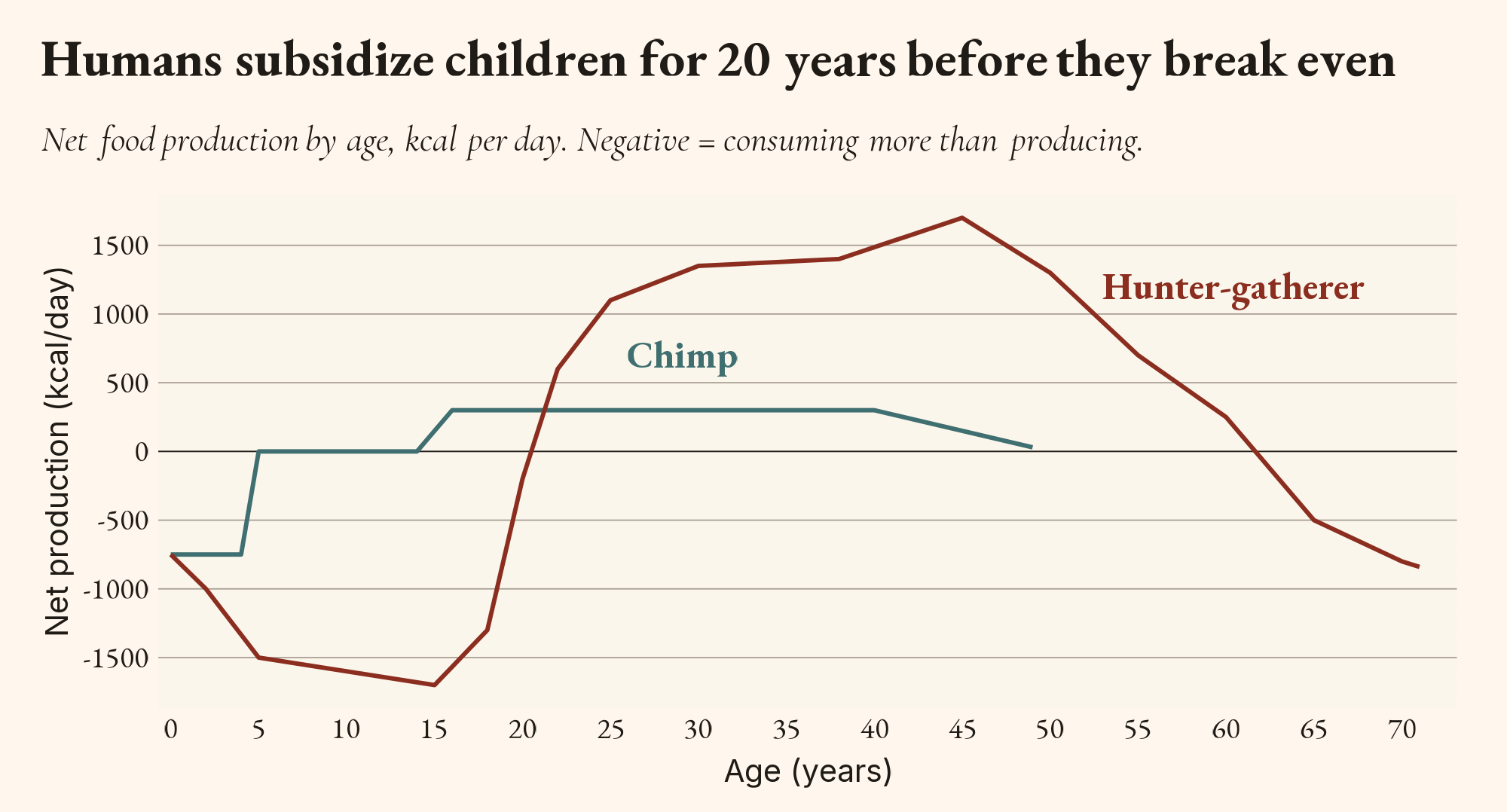
The payoff for this early investment is that human peak net production reaches about 1,750 kcal per day at age 45 while the best chimpanzee tops out around 250 kcal. This high return pays off because humans live 20 years longer. In short, humans are much better investments, if you can make it work.
Did you hear that paternal investment was the way to make it work? If so, it is wrong. Not only does evolutionary comparison across related species suggest that paternal care evolves only after monogamy becomes established in a population, but the idea that two hunter-gatherers, no matter how invested, could raise children alone is absurd on its face.
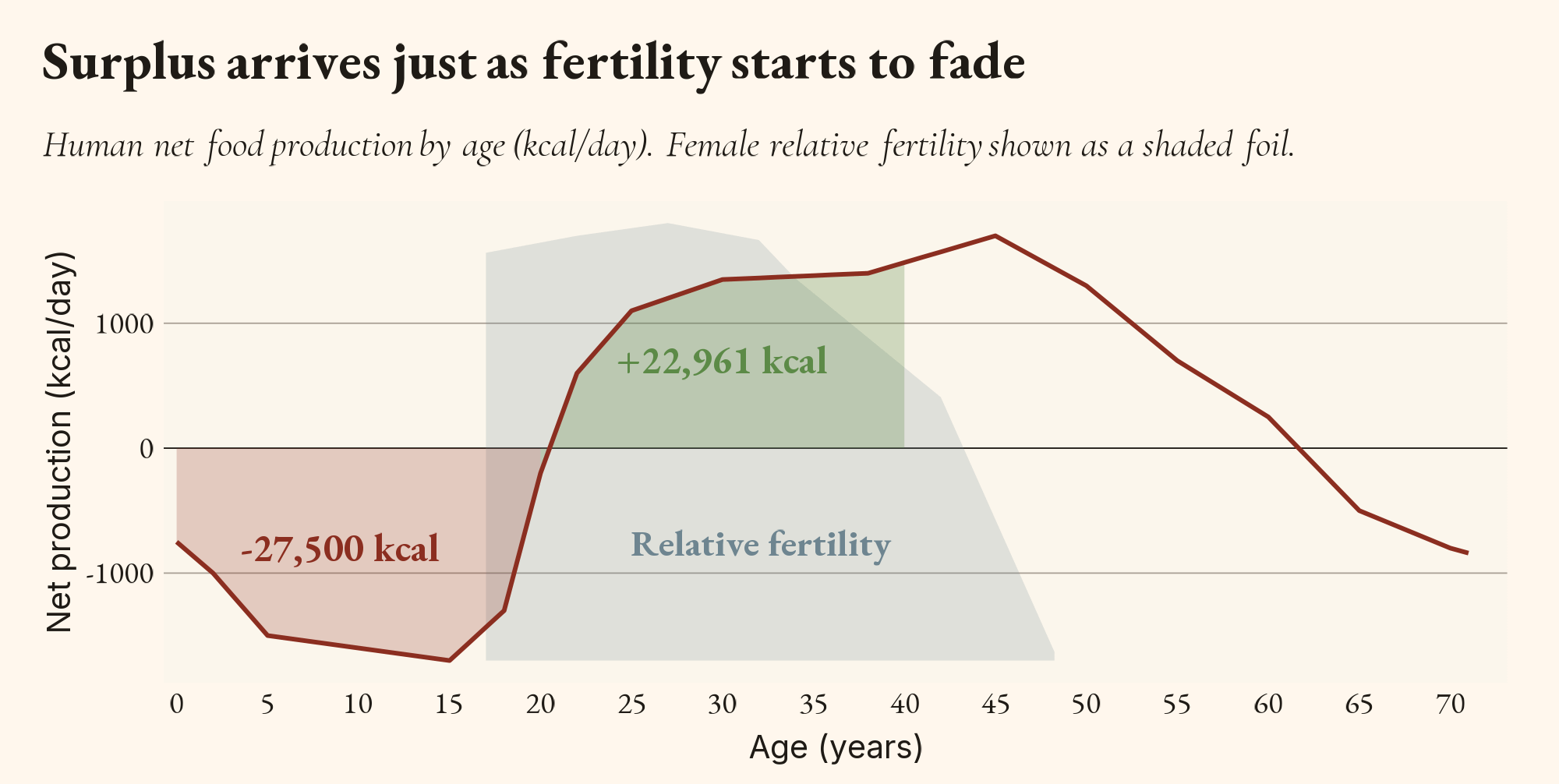
Human children remain dependent for nearly as long as women remain fertile, so all your children stay dependent in overlapping years. In addition to food, nursing children takes time and diminishes women’s gathering by more than 60%. The result is 1.4 full-time equivalent gatherers in a couple, which can very optimistically support 1.4 children. Let’s not even consider the 50% child mortality rate.
No, what makes child raising work is cooperation, it takes a village as they say. Reinvesting late life surplus means grandparents. A 20-year-old woman raising a child gets less from her 20-year-old partner, who can barely feed himself, than from her own mother and the rest of the camp. Not that the father doesn’t pitch in.
The cooperation extends beyond family to the entire group. The high caloric returns of those graphs already include cooperation and task distribution. Men primarily hunt mammals and birds with bows and collect wild honey bringing into camp about 45% of daily calories. Women dig wild tubers, gather berries and collect baobab fruit, collecting 55% of calories, severely reduced when nursing a child.
Gendered distribution is just one way to spread knowledge. Each skill already takes years to learn. This way nobody has to learn them all but everyone can benefit by specialization and sharing.
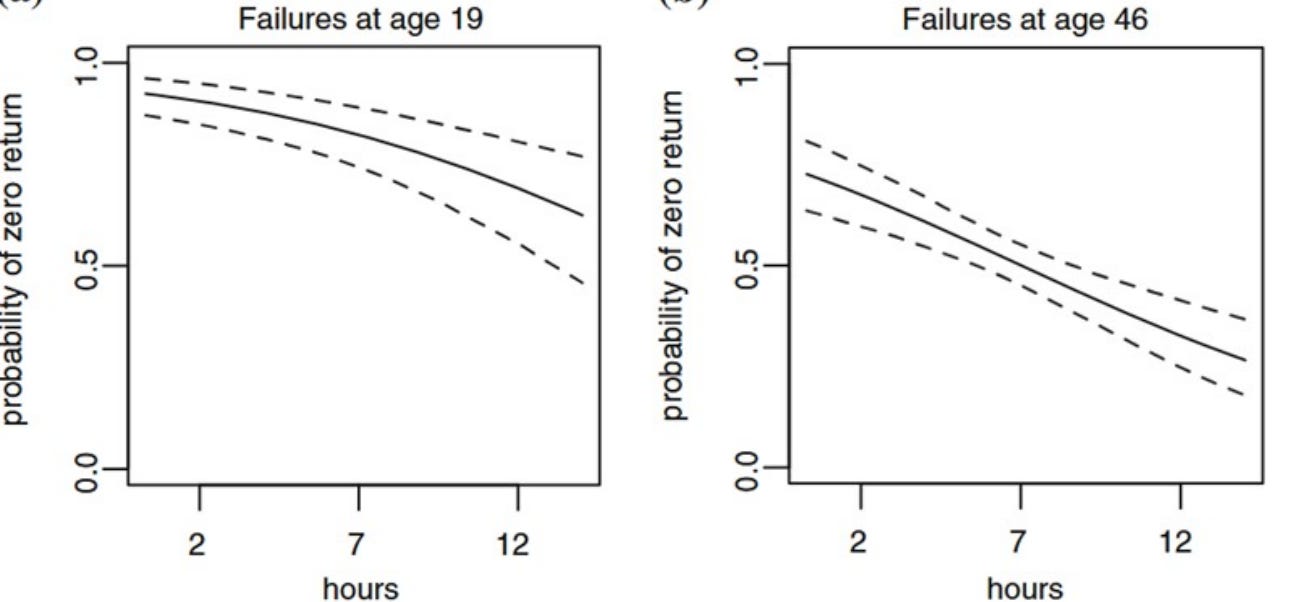
Sharing is also insurance. Even the best hunters return empty-handed almost half the time. Only by sharing can this type of high-reward, high-variance activity be sustained in primates.
What does it matter for sexual relations? Because now you have huge group benefits from egalitarian sharing and a high inter-dependency. Nobody benefits from trying to dominate the person who might feed him tomorrow. In this ecology it is not territory that is defended, like chimps, nor reproductive access, like gorillas, but cooperation access.
Among hunter-gatherers, when anyone tries to dominate, others ridicule him, withdraw cooperation, and if it isn’t enough, move away. This prevents coercive dominance, the kind a gorilla silverback needs to monopolize females, but it does not prevent prestige. Since no one can coerce or out-resource everyone else, pairing stays mostly one-to-one, meaning some form of monogamy, at least as observed in modern hunter-gatherers.
Among the Hadza, one of the well-studied modern hunter-gatherer people in northern Tanzania, marriage simply means that a couple has begun living together, which usually follows a brief, somewhat discreet courtship. With the village taking care of the children’s needs there is freedom for the women to choose their match and very little reason to be a second wife to anyone. This creates a situation referred to as a stable matching problem.
Every man wants to marry the highest-status fertile woman he can. Every woman the highest-status man she can. But status is not something you can read out of the air and is instead evaluated via mate criteria such as good looks, good character or intelligence and fertility for women. Mathematically, there are multiple ways to achieve a stable matching where everyone has done as well as they could. In reality you learn to know people, priorities change, or you are too afraid to ask someone out, which means stable states are not often reached. This is serial monogamy and only about 20% of Hadza stay married to the same person their whole life. A divorce here is just someone walking away from the common home and living somewhere else, usually caused by extramarital affairs.
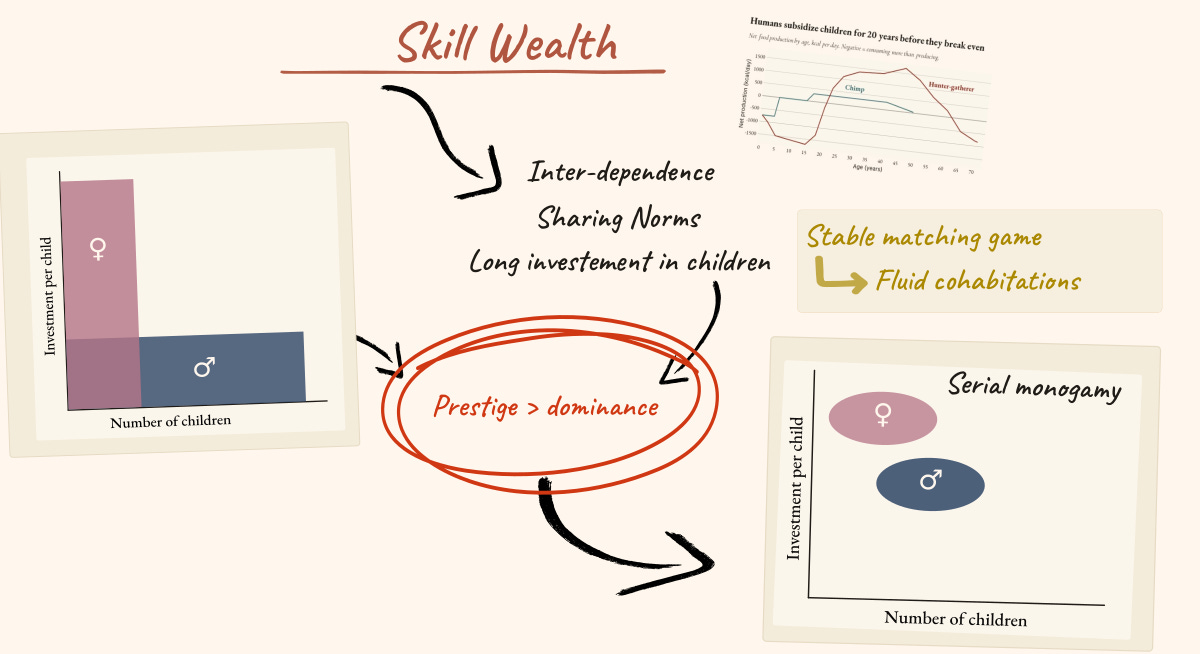
In this matching game, men who are the best hunters have more prestige and more surviving offspring because of a higher chance of marrying young women upon divorce. In this new form of competition, we observe that, if men contribute to child raising significantly, they still invest more resources than women in raising their own status.
Since this was our environment for hundreds of thousands of years, we can expect our bodies and minds to be shaped by this system like those of chimps and gorillas. As far as bodies go, men are only 15% heavier than women, suggesting minimal dominance fight. But bodies are the easy part, what about our minds?
Away from the evolutionary logic, in our daily experiences, we do not consciously orchestrate reproductive strategy but we experience desire, attraction, jealousy, attachment, heartbreak. As many ways to alter the shape of our behavior, but at the core, neuroscience defines three drives to organize sexual life. Not emotions. Emotions come and go, while drives are persistent forces that organize behavior, the way hunger organizes eating. If we have trouble describing what love feels like, it might be because love is a drive producing many feelings in its wake.
Sex drive is the desire to have sex with what we identify as viable candidates. Underrated in its ability to steer us away from attempting sex with trees or other animal species.
Then there is romantic attraction which focuses attention on one person and dampens interest in everyone else, running on pathways overlapping with gambling and obsessions. In most mammals it lasts a few minutes. In humans it lasts 1 to 2 years, enough to signal commitment, sustain cooperation through the highest-risk months of pregnancy and infancy, until attachment takes over.
Attachment is what stabilizes relationships which extends beyond sexual partners to family and friends, building through repeated positive interactions and mutual dependence.
A changing environment calls for a wanting-system that bends. Not a fixed plan but things to look for. In humans, the strong predisposition is to forge long-term bonds of some kind, the one consistent finding across societies. The rest depends on the soil.
The cost of this flexibility, as we know from experiencing it, is that satisfying any one drive often means going against another. Perhaps this is what makes us seek answers from science: Are we monogamous or polygamous? What should I do?
That forager’s answers held for thousands of years until 10,000 BCE when we ran two experiments back-to-back, the domestication of animals and agriculture. Each one reshuffled mating rules in a way the Hadza wouldn’t recognize.
Investing in Wives
The domestication and introduction of cattle changed the sharing equation. Unlike gathered food, cattle survive, give milk, and reproduce to make more cattle next year, the earliest form of compound interest. Cattle can also be moved, traded, raided, or given as bride price. If this wealth needs labor to attend to, it has much less variability in returns than hunting and ultimately leads to inequalities. When I have 10 times more than you, I am suddenly less inclined to share equally. And if I can move my cattle to another group, you are less inclined to force me to share as long as you can obtain some benefit from me. With inequality comes the erosion of the sharing economy and the rise of individual independence.
Cattle also created a problem our ancestors had never faced: what do you do with your wealth when you die? Everywhere pastoralist living emerges, patrilineal inheritance follows (male children inherit). Polygamy arrives when wealth concentration requires a biological outlet. Male reproduction has no ceiling, so disproportionate resources buy disproportionate offspring.
With reduced sharing, couples must rely primarily on their own resources to raise children. This makes male inheritance more profitable, for both parents. The mother has as much interest in her sons to inherit all the wealth to secure higher status and more wives while she can marry her daughters to other wealthy men.
This makes women dependent on men, which is part of the system. This is how being the second wife of a wealthy man becomes preferable to being the only wife of a poor one. Because in pastoralist regions, the children of polygynous fathers tend to be wealthier and better nourished than those from monogamous marriages.
The dominant male then does not need to be twice as strong, only twice as wealthy. Since wealth tends to accumulate with age, this often means younger women married to older men.
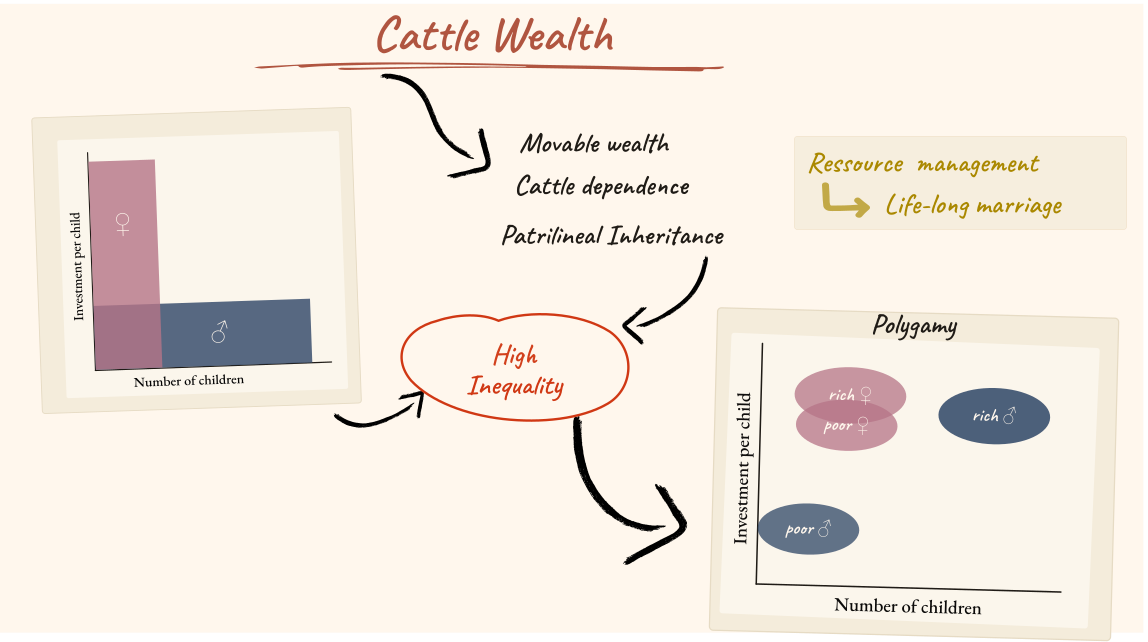
All of this only works for men if the children are actually yours. Paternity certainty becomes central in pastoralist sexual politics, as pastoralists spend months away with the cows. A default answer is control of women’s movement and contact but looking at different cultures shows more subtlety.
The Himba (still living in northern Namibia today) are polygamous pastoralists where, surprisingly, almost 50% of children are not the biological offspring of the man raising them. Even more surprising, the father knows it. Young men, high in sex drive and low in resources, have children with women who are already married before they can support them. The older married men raise those children as their own, like their elders did for them. Women benefit because boyfriends will also contribute gifts to help their children, providing resources beyond what the husband alone offers. Instead of trying to suppress extramarital affairs they are discussed and managed, allowing everyone to pursue their romantic drive while ensuring children have what they need. The problem of cattle inheritance and paternity certainty is side-stepped by going to nephews (male children of a man’s sister) rather than children.
The Maasai in East Africa do things differently. Young men enter warrior camps at puberty and stay for 15 years, separated from the village and from marriage. Warriorhood is how you get prestige and boys aspire to it. In regard to polygamy, the structural effect is to remove one generation from the dating pool entirely and prevent intergenerational sexual competition before it starts. During the decade and a half, raids build reputations while shared meals and survival build the trust that makes them brothers. And brothers don’t cheat on each other. When warriors return, proven by years of service, they marry younger, fertile women, who have not spent a decade and a half in warrior service. Reputation earned in service weighs in on marriage arrangement but so does the wealth of your parents. Women have little official say in marriage choice, negotiating behind the scenes. In the end, most wives are married to elders carrying both demonstrated competence and cattle-wealth, the dual currency that maximizes reproductive success, if not happiness.
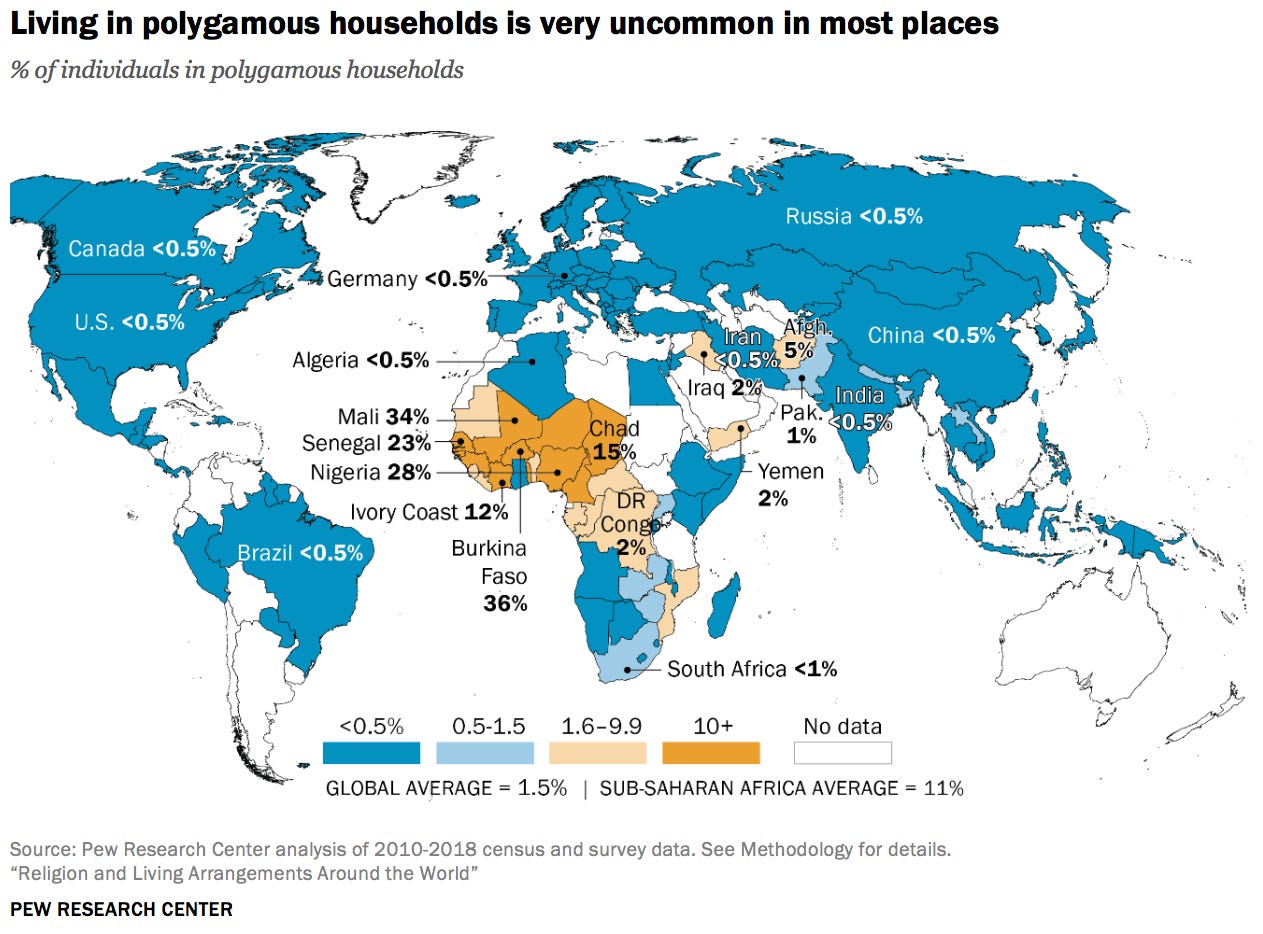
Both are pastoral solutions to pastoral problems. Today’s largest concentration of high-polygamy cultures sits in West and Central Africa, previous pastoralist logic now shifted into land and trade economies. The west has instead inherited more of an agriculturalist culture.
Gorilla Warfare
An agricultural village stores a year of calories in one place and cannot move away from the fertile and irrigated land. Suddenly, food distribution looks more like that of gorillas: local, abundant and prime for the taking by any 20-year-old, not knowledgeable enough to survive in the wild but fit enough to hunt immobile farmers. When pre-agricultural violent mortality runs at about 3% of total deaths, early agricultural societies reach 9% thanks to the emergence of the first wars and warlords. From warlords and protection rackets to early states stretches a thousand years of cultural experimentation.
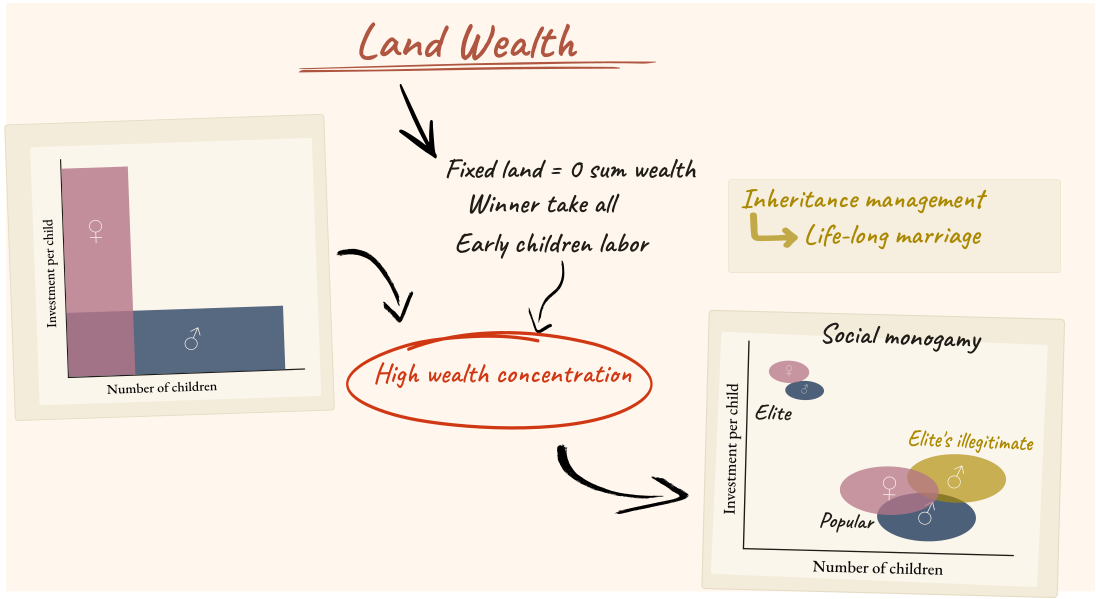
Gorillas were about controlling females’ access in a world of abundant food. Humans, whose food requires some mixture of labor, skills and cooperation, found a different solution. Control the stored surplus and you control the conditions under which women can raise children. Add high inequality to the mix and you fall back to the same logic as the pastoralists except for the fact that land-wealth and cattle-wealth differ in meaningful ways.
Land does not reproduce and multiply like cattle does. It instead requires constant labor and irrigation which usually implies large scale coordination enforced by rules. Also, lands are very large targets that require protection to generate food. In this context, strength lies in the size of the armies you can feed to defend your land. Too small and you lose everything to the bigger neighbor. Divide wealth too much by multiplying inheritance of your children from multiple wives and you lose everything. Inheritance then must stay within a close family. Concentrating inheritance in even fewer children makes paternity certainty concerns go through the roof, as the oldest recovered legal texts can attest, like the Code of Ur-Nammu (ca. 2050 BCE):
“If the wife of a man followed after another man and he slept with her, they shall slay that woman, but that male shall be set free.”
The double standard couldn’t be clearer. Paternity certainty via sexual restriction in exchange for inheritance while in many cultures men are allowed to have official concubines as long as the children of those unions don’t inherit.
Why would the state care to enforce this? First, because states are initially formed by the few percent who own the land. Also, because a landed elite whose wealth fragments with each generation becomes administratively useless to the state. Fewer, larger, stable units of concentrated wealth are legible, taxable and capable of providing military protection. Marriage law is an infrastructure for inheritance, not public interest in a happy family life. In the more extensive Code of Hammurabi law text from 1750 BCE, we find many regulations on inheritance and sexual rules. The law is as preoccupied by this as by taxes: One primary wife per man. Concubines tolerated but secondary wives only on conditions like infertility. Female adultery is punishable by death but so is rape (more conditionally):
“If a man forces the (betrothed) wife of another who has not known a male and is living in her father’s house, and he lie in her bosom and they take him, that man shall be put to death and that woman shall go free.”
Women keep the right to divorce and have a guarantee of financial support if the husband is the one divorcing. The protection runs both ways because marriage is an investment and elites have daughters too. What the laws capture is a stable system that protects reproductive interest with its asymmetries, a colder optimization than equality.
Those laws are similar to those that emerge later in Greece and then Rome, made to address the concerns of the elite. Depending on regions, this will be called polygamy or social monogamy but they are the same system with the only difference being whether concubines can be called wives and are offered some amount of status.
The picture is different for the 80% living in the countryside, where there is often little to inherit and where we can be skeptical of the reach of official law. Here too we find monogamy but of a different kind, subsistence monogamy. Farming gives a greater degree of self-sufficiency than hunting, reducing the village to dispersed family households. This increases the importance of paternal investment which, in addition to the mother’s contribution, becomes central to the success of the household. Given the difficulties of farming, few men can realistically support multiple families, meaning monogamy imposes itself.
With no worries about dividing their wealth, having many children is preferred especially since they can contribute labor to the farm early.
What might have spread better than the law in the countryside are beliefs and religions, tools that also serve to entrench and justify working systems2. While we cannot easily study behavior of early religious followers, in modern times the single highest correlate, by far, of religiosity in Western individuals is moral sexuality. Meaning their positions on nonmarital or casual sex, abortion and pornography. Again, sexual norms are found at the heart of identities.
Over time the concubines become less visible, the death penalty becomes a social stigma, and the language shifts from legal code to virtue. Chastity, purity, legitimacy, all different mechanisms enforcing the same results. Legal monogamy, in all the forms it takes across countries, descends from this system and represents the most common marriage law. But if you are reading this, chances are that you are a product of the rise of education after the Industrial Revolution.
The Capitalist Village
In the agricultural era, we traded high-skill foraging for high-labor plowing, reducing the 20-year investment in child raising. But today in WEIRD societies (Western, Educated, Industrialized, Rich, Democratic), we have returned to the high-skill timeline of our ancestors.
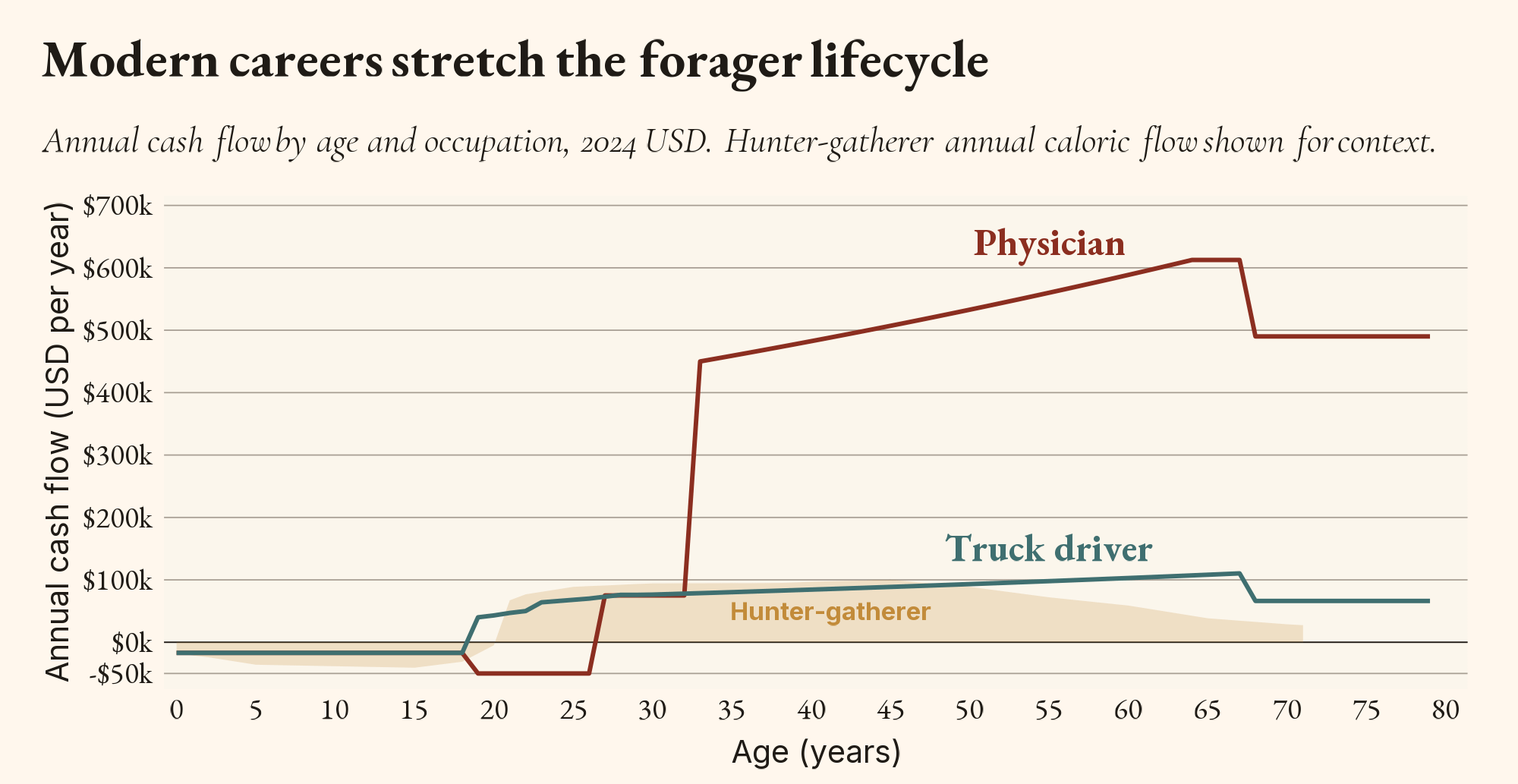
The returns on 18 years dependence are better than for hunter-gatherers, but why stop here? 25 years of education, colleges, apprenticeships, all investments that return exponential incomes and status. This logic reserved for elites and their heirs now applies to almost anyone through education and job market competition.
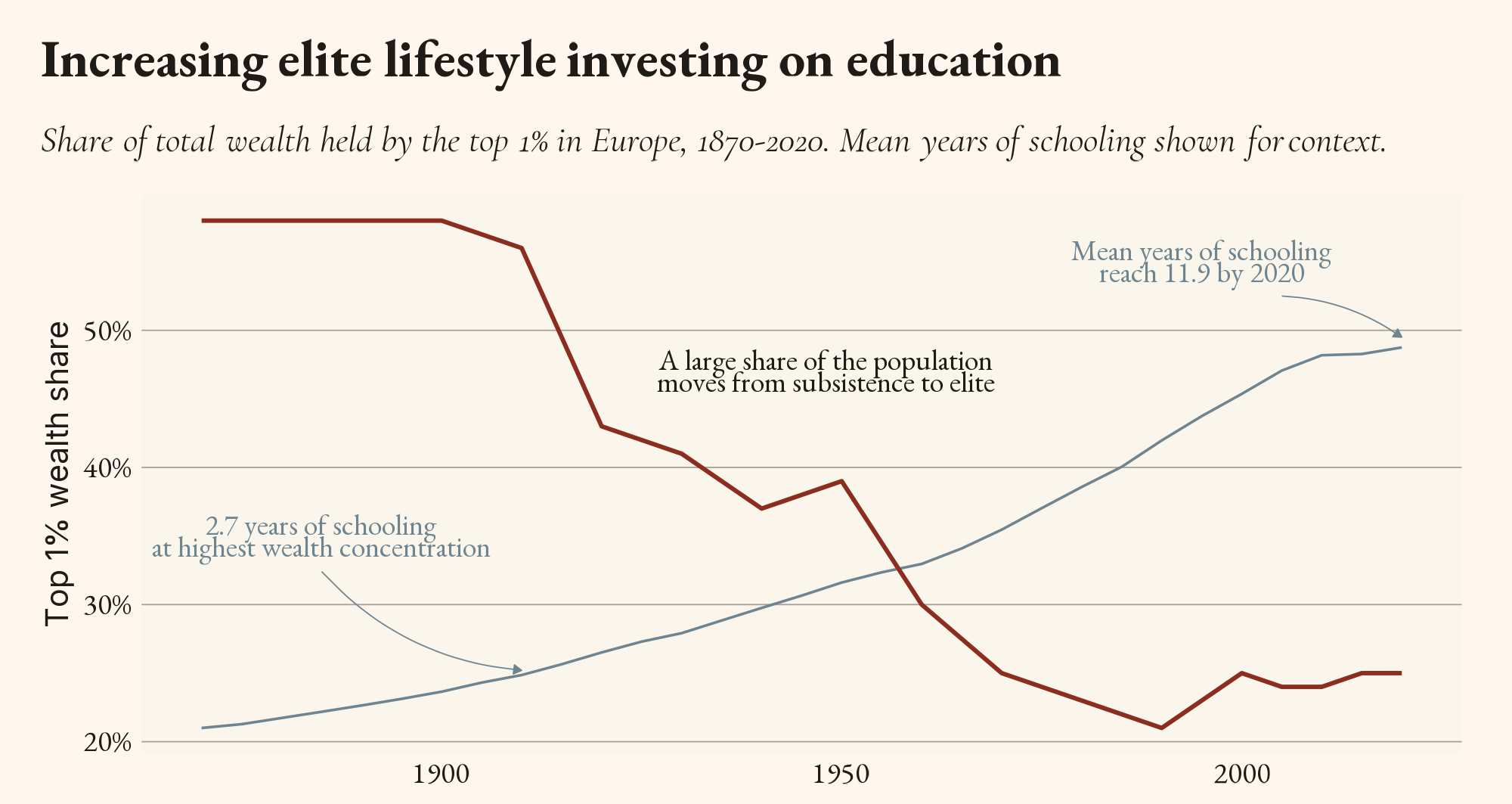
The new winning move, even for males, is compound interest on each child rather than increasing the head count. European transition in early 19th century lacks fertility data, but this can be observed in real time in India.
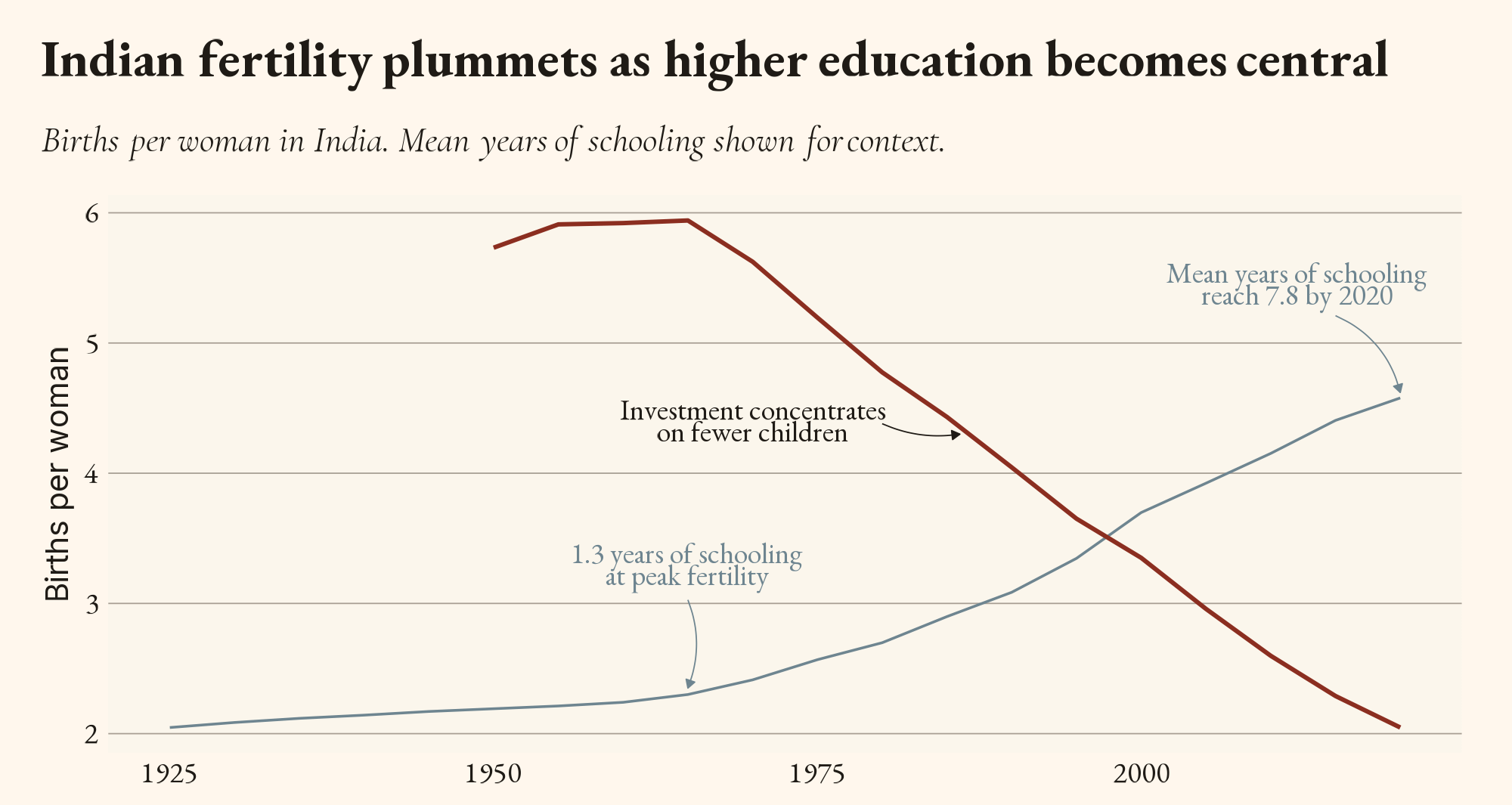
This effect on family planning has yet to affect sexual relationships. These track more closely the mechanism we followed from the start, who depends on whom to fulfill basic needs. Elite monogamy had women depending on men for wealth. When women can earn, own property, and purchase support for child-rearing, marriage stops being a necessary contract.
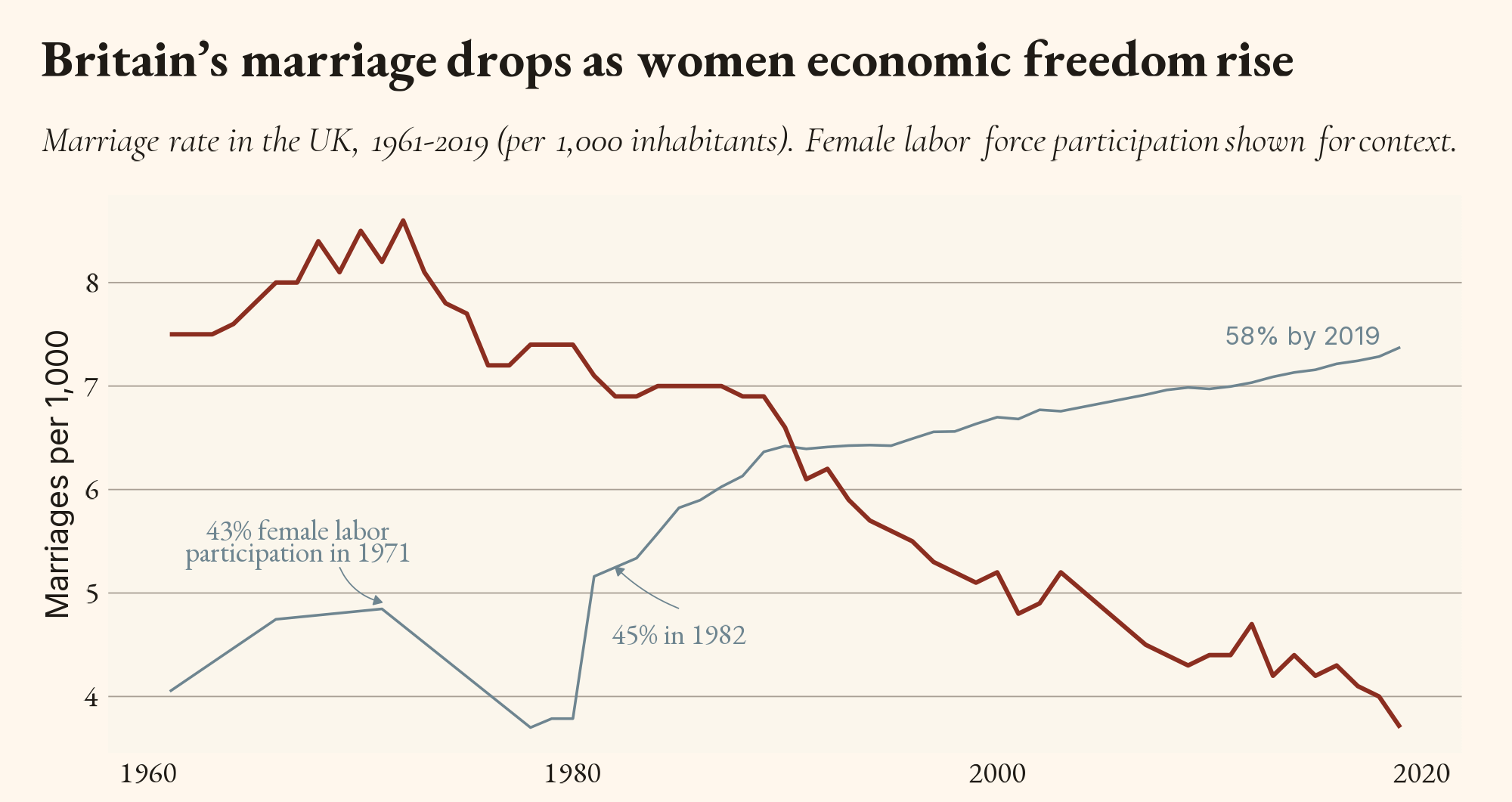
Britain had the most complete data but we find the same at the EU level with marriage rate of 8 per 1000 people in 1964 halving to 4.2 in 2022. Over the same period, the divorce rate has doubled.
We return to a more equal footing closer to our hunter-gatherer ancestors and our stable matching problem. Only now the costs of raising children sit within the household and parents are expected to secure stable income and housing before having children, pushing reproduction later and later into life. In this context, men and women both tend to seek partners capable of matching or exceeding their own contribution to the household. Stable partnerships become a way of pooling resources between two individuals to invest in children.
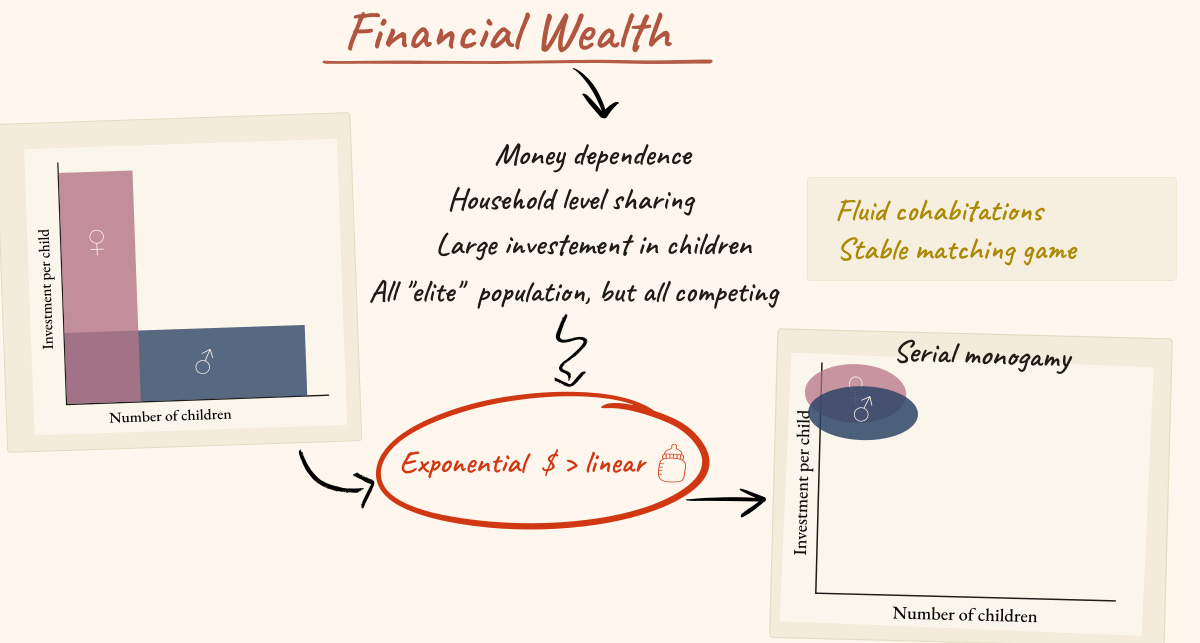
While convenient, these partnerships are not always necessary. With enough resources, raising a child alone is now possible, and sharing money doesn’t necessarily mean living together. In 2023, 20% of child-raising households were single-parent in Nordic countries and Western Europe.
The return of serial monogamy is clearest in how many serious relationships people have.
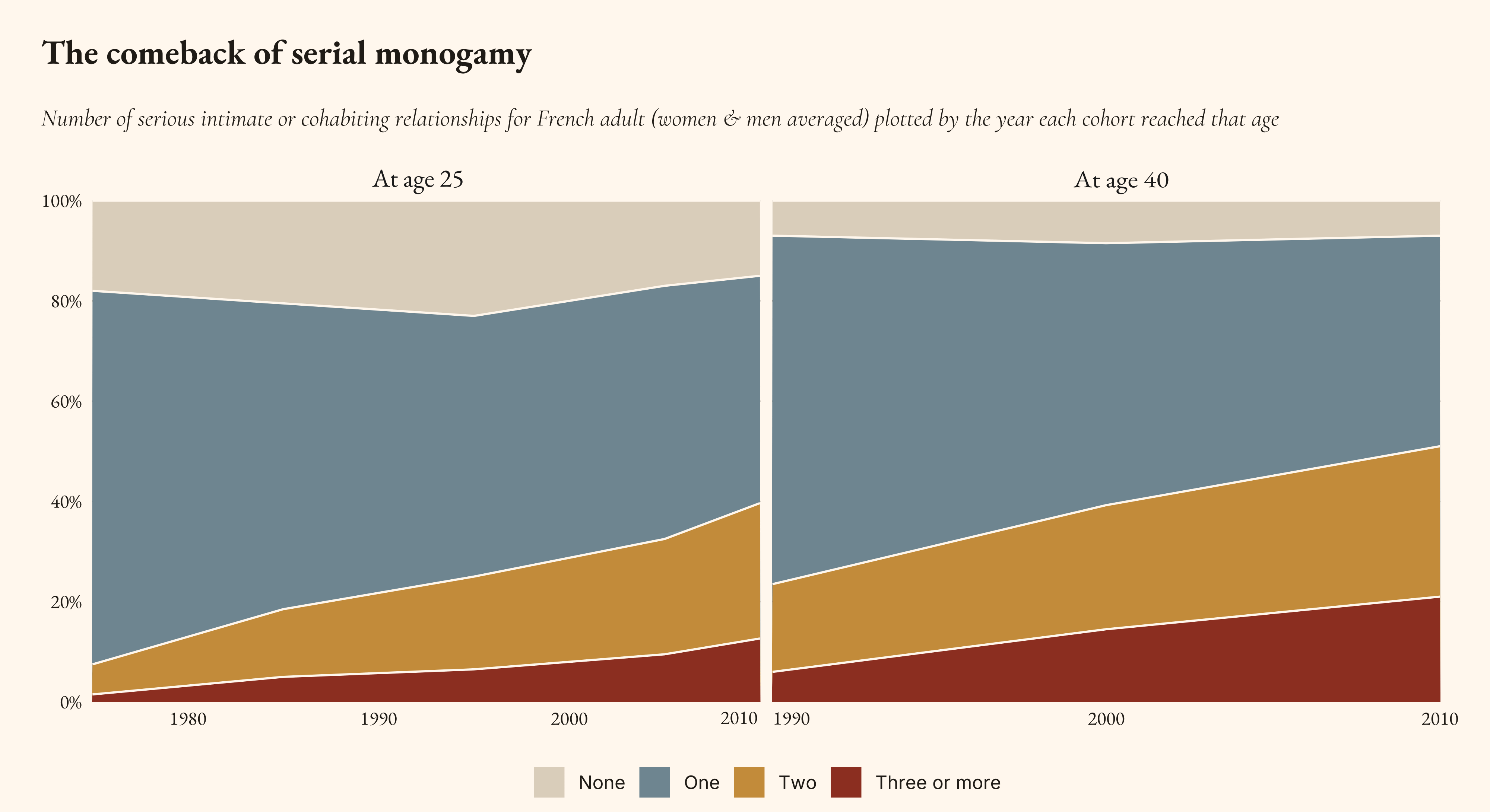
Fidelity is expected within relationships, yet multiple long-term partnerships across a lifetime are common. Status used to be hunting skill, now it’s education, occupation, income.
The Hadza have no marriage rules and only 20% lifelong partnerships. We’re only catching up.
Takeaway
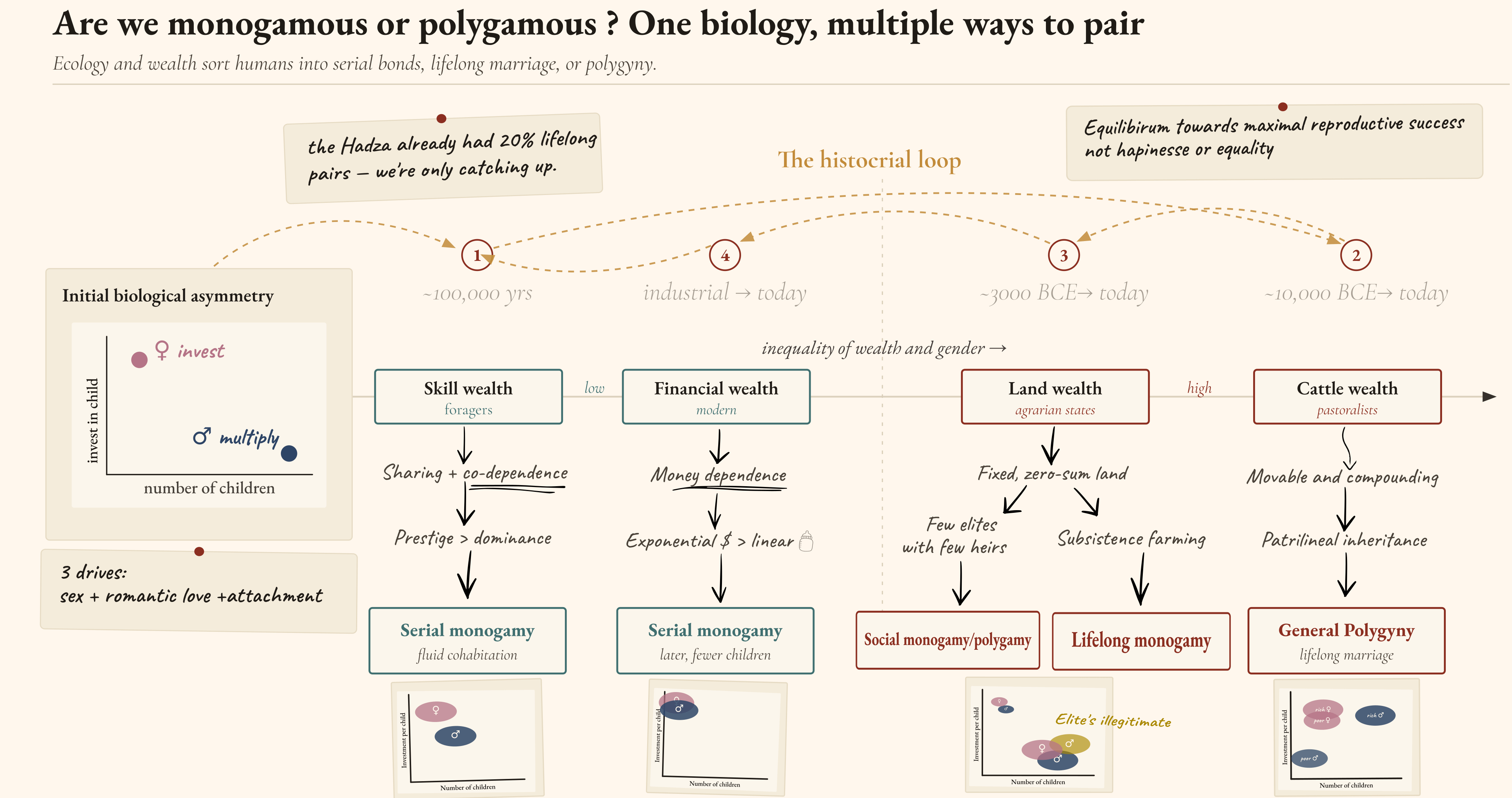
Asking whether humans are monogamous or polygamous is asking about the true shape of a tree (there isn’t one, just to be clear). We aren’t made for any mating system, any more than we’re made for democracy. The forager or the pastoralist equilibrium aren’t boxes. They’re the outcomes of who depends on whom for resources. Change the inputs and the output shifts, predictably. Add variables beyond food and wealth and you explain even more twists in the tree: Maasai one way, Himba the other, both still pastoralist. In any case there is no buried truth about human sexual nature to uncover.
Why grandchildren and not just children? Direct consequence of inclusive fitness (Hamilton) and the gene’s-eye view of Dawkins. If selection acts on gene copies in the next generation, it doesn’t care which body carries them. Your offspring, your siblings’ offspring, your cousins’ offspring all carry your genes at different rates (1/2, 1/4, 1/8, and so on). The calculation that maximizes gene copies, in any species, weights kin by relatedness. What varies between species is what strategy satisfies the math.
There is the punitive spirit Sikameinan among the Mentawai horticulturalists, believed to attack people who fail to share meat within their clan. There is also the Selk’nam of Tierra del Fuego, where men maintain beliefs in a punitive spirit that supposedly punished women who disobeyed their husbands and then there is the New Testament “Because of temptation to sexual immorality, each man should have his own wife and each woman her own husband.” All enforcing interests, many of which are sexual conduct rules.